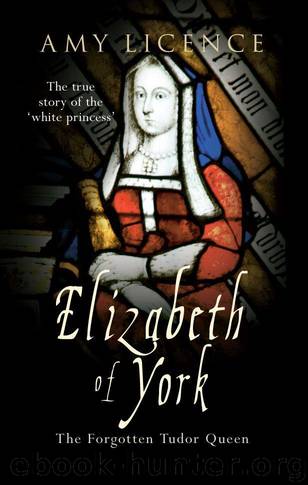
Elizabeth of York: The Forgotten Tudor Queen by Amy Licence
Author:Amy Licence
Language: eng
Format: azw3, mobi, epub
Publisher: Amberley Publishing
Published: 2013-09-02T00:00:00+00:00
6
MOTHERHOOD, 1486–7
I love the rose both red and white
Is that your pure perfect appetite?
To hear talk of them is my delight!
Joyed may we be
Our prince to see
And roses three.1
Elizabeth must have begun to suspect she had conceived by the early spring of 1486. For the early months of the year, the newly-weds were at Westminster as Henry continued to attend to the business of the new regime. This included orders restoring the reputation and providing for his mother-in-law, the widowed Elizabeth Wydeville. For the young wife, it was a period both of adjustment and continuity. On one hand, she had the security of being restored to the only home she had ever really known, Westminster Palace, whose familiar Great Hall, tilt-yard and royal apartments had witnessed the critical moments of her life. On the other, she was no longer the princess, legitimate or not, dependent and waiting for her moment to come. Her marriage had propelled her into the heart of events as an important figure in her own right, the representative of her husband’s rule and possible intercessor on behalf of those seeking his favour. On a personal level, she was adapting to life with a man, virtually a stranger to her, to whose will she was completely subject. In addition, she had to realign her relationship with her new mother-in-law, the formidable Margaret Beaufort, who was beginning to take an increasingly prominent role in their lives. Her own mother and sisters were still close but it must have been a time when the still-fluid hierarchy of the new royal family was being established. Amid the bustle of courtly life, with all its demands, Elizabeth was adjusting to her new role as her body began to change. Perhaps at first, with all the business of the new regime, she merely felt more tired than usual but soon, certain signs would have led her to suspect there was more to her condition.
Pregnancy was not easy to establish in the fifteenth century. There were no reliable testing systems, as are readily available over the counter today. Folklore and superstition had their methods but these were as unreliable as they were unscientific. Only the appearance of certain physical symptoms might lead an expectant mother to conclude she had conceived, yet there were still no guarantees. The proliferation of common infections and untreatable illnesses could lead these symptoms to be mistaken or confused for other diseases. Even a bloated womb could signify something more sinister, while the cessation of menstruation was dependent upon nutrition and body weight. Contemporary herbals are full of remedies to bring on the ‘flowers’ or ‘courses’, suggesting that amenorrhoea must have been a common problem. Only with the child’s quickening around the fourth month could a pregnancy be diagnosed with any degree of confidence. When it came to her first child, Elizabeth must have relied on the experience of her mother and mother-in-law to help confirm this. There was also a Dr Lemster, recently appointed by Henry as his
Download
Elizabeth of York: The Forgotten Tudor Queen by Amy Licence.mobi
Elizabeth of York: The Forgotten Tudor Queen by Amy Licence.epub
This site does not store any files on its server. We only index and link to content provided by other sites. Please contact the content providers to delete copyright contents if any and email us, we'll remove relevant links or contents immediately.
Waking Up in Heaven: A True Story of Brokenness, Heaven, and Life Again by McVea Crystal & Tresniowski Alex(37808)
Empire of the Sikhs by Patwant Singh(23084)
We're Going to Need More Wine by Gabrielle Union(19045)
Hans Sturm: A Soldier's Odyssey on the Eastern Front by Gordon Williamson(18590)
Leonardo da Vinci by Walter Isaacson(13336)
The Radium Girls by Kate Moore(12026)
Tools of Titans by Timothy Ferriss(8393)
Educated by Tara Westover(8053)
How to Be a Bawse: A Guide to Conquering Life by Lilly Singh(7486)
Permanent Record by Edward Snowden(5846)
The Last Black Unicorn by Tiffany Haddish(5635)
The Rise and Fall of Senator Joe McCarthy by James Cross Giblin(5280)
Promise Me, Dad by Joe Biden(5153)
The Wind in My Hair by Masih Alinejad(5095)
A Higher Loyalty: Truth, Lies, and Leadership by James Comey(4959)
The Crown by Robert Lacey(4814)
The Iron Duke by The Iron Duke(4354)
Joan of Arc by Mary Gordon(4109)
Stalin by Stephen Kotkin(3965)
